Wednesday, March 25, 2015
The elusive IMBH in Omega Centauri
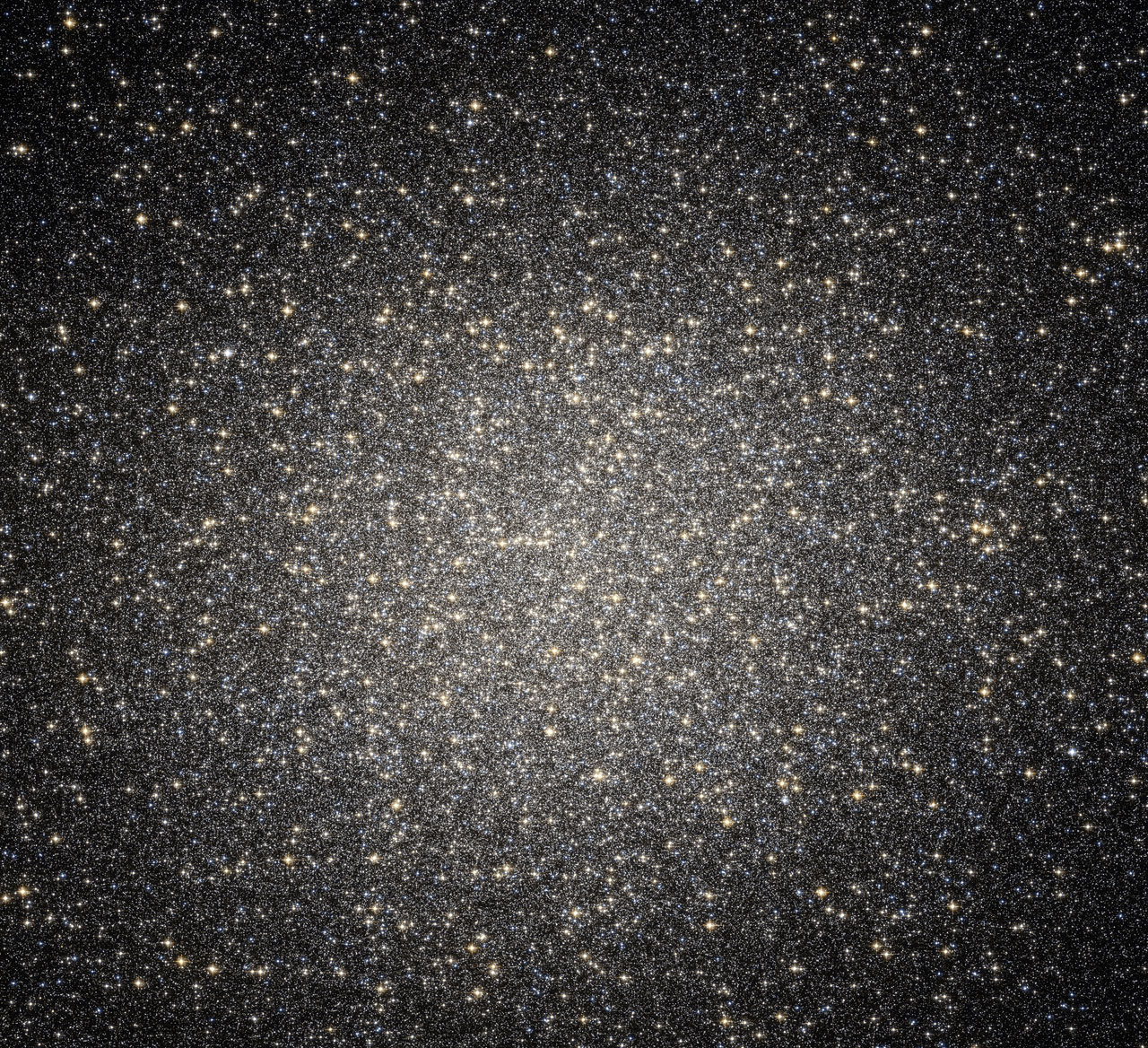
Recently, I have had the opportunity to examine Dr. Pryor's work. Among his work with globular clusters and dwarf galaxies, there were hints that the possibilities of IMBHs (intermediate mass black holes) existed in some of the systems studied. Relating to this field, the most notable celestial phenomenon is Omega Centauri. This system has undergone many classifications: Over two thousand years ago, Ptolemy catalogued it as a single star. In 1677, Edmond Halley classified it as a nebula. In the 1830s, John Herschel recognized it as a globular cluster. Now, astronomers are not so sure that Omega Centauri is a globular cluster, but in fact a dwarf galaxy that has had its outer stars stripped. You might be tempted to ask: What is the basis for the reasoning that Omega Centauri is a dwarf galaxy and not a globular cluster? It shares all of the properties of regular globular clusters, so what's the deal? It turns out that Omega Centauri, although similar to other globular clusters, is a bit more unique in terms of its physical description. It rotates faster than the general distribution of globular clusters, it is also highly flattened and contains many generations of stars (typical clusters only have one generation of stars). Furthermore, Omega Centauri is about ten times more massive than the average globular cluster, making it nearly as massive as a dwarf galaxy! Moreover, the speeds of stars closer to the center of the system are relatively incredibly higher than expected. The stellar velocities are directly tied to the mass of the cluster itself; the findings indicated that the mass of Omega Centauri was not enough to compensate for the speeds observed. Rather, the team at the Max-Planck Institute for Extraterrestrial Physics highly suggested that in order to properly account for the speeds observed, there would have to be a black hole at the center of Omega Centauri that has approximately 40,000 solar masses! Before any justified skepticism from the viewers, there is precedent for this type of research. There was a globular cluster in Andromeda classified as "G1" that shared these properties and had an IMBH in its center. This further supports the idea that Omega Centauri has an IMBH in its center as well! It is hypothesized that past interactions with the Milky Way caused Omega Centauri to distort, and it is also suggested that this system could be a possible model for black hole formation. For anyone interested, the link is here: http://www.spacetelescope.org/news/heic0809/


Saturday, March 7, 2015
Behold! The first image of light as a particle and a wave!
Scientists throughout the 20th century have
always worked to great lengths in order to conceptually understand the tenets
of quantum mechanics. One of these great principles of quantum mechanics is the fact that light (or any other quantum object) can only interact with matter
as either a particle or wave - never both at the same time. It is either one
form or the other. The reason behind this is because of the fundamental nature
of observing the quantum phenomena. For example, if an electron gun fires electrons
at slits that have lengths smaller than the wavelength of the electron itself,
then an interference pattern would emerge. If we ever try to observe the
electron before it hits the slits, then we would need to use light to observe
it (just like anything else). The problem is, as soon as we add light to the
electrons, they will gain energy because of the photons (light particle)
scattering off of the electrons! This will destroy the system and provide no
meaningful results. Recently, a science team at EPFL (École Polytechnique Fédérale de Lausanne) came up with
an interesting experiment that resulted in the first image of light behaving as a particle
and a wave simultaneously! The trick was to think about the imaging process:
instead of using light to image electrons, use electrons to image light. The
way they did this was by setting up a laser that fired a pulse of light at a
nanowire; this resulted in a standing wave radiating around the wire. Then the
researchers shot electrons near the wire, forcing the electrons to scatter off
the photons. Using the ultrafast microscope, they were able to image the
interactions between the photons and the electrons! The bumps in the image are
the accelerations of the electrons (changes in speed because of the collisions) at each part of the standing wave set up in
the nanowire. This basically means that the standing waveform of light in the
nanowire was successfully visualized by just using electrons! And don’t worry,
these results do not invalidate any principles of quantum mechanics; in fact
they reinforce them. In the image, we can see the standing waveform of the
light, and we can simultaneously see the interactions. This proves that the
electrons are physically interacting with the particles of light – the photons.
Voila, light is both a particle and a wave!

Thursday, February 19, 2015
Time for solar physics! A discussion on Alfvén Waves
There have always been two very serious questions in the scientific community of solar physics: 1: Why is the solar corona hotter than the surface of the Sun? and 2: Why does the solar wind gain so much speed when it leaves the Sun's atmosphere? These questions are inherently complex, since the physical phenomena are not logically intuitive. Let me frame some examples. For the case of the corona: assume I provide an operational light bulb that radiates light from its surface. As one would expect, the intensity of the light should decrease as the distance increases. As simple as this seems, the solar corona, which is located millions of kilometers above the Sun's surface, does not obey this statement. The corona, which is a plasma-filled region (plasma is hot, ionized gas that interacts with magnetic fields strongly), is immensely hotter than the surface of the Sun! The Sun's surface is measured to be about 5770 K, while the corona is measured to be about 1.7 million K! Clearly there is some hidden mechanism that is eluding scientists. For the case of the solar wind, the situation is much simpler, but there is still no clear explanation for it. There exists the solar corona, a magnetically active region that moves plasma continuously. However, from this solar corona ejects the "solar wind", which is a collective of charged particles that extends out into the Solar System. The question is: how does the solar wind leave the corona and how does it gain such high speeds? What mechanism is responsible for providing the energy for such a phenomenon? Luckily for solar physics, there was a theory proposed in 1942 by Hannes Alfvén that predicted the existence of "magnetic plasma waves", which potentially solve both of these problems! Here is the core of the theory: The magnetic field lines around the Sun fluctuate incredibly, and they serve as a good medium for waves to travel on. Since plasma permeates the space around the magnetic field lines, the plasma interacts with the field and "sticks to it". Now, the magnetic field lines are like strings tied from both ends; when they are perturbed, the matter on the string will stay still, but oscillations will produce as a result. So the plasma oscillates on the magnetic field lines continuously, and these waves carry energy which transport that energy to the corona. This can trigger a heating effect, which is what is possibly observed in the corona! On top of that, these waves, coined Alfvén waves, theoretically carry enough energy to accelerate charged particles into the Solar System at speeds of 300-600 kilometers per second! This process is a jackpot for solar physics, and if more technology is introduced to study the Sun's atmosphere, this information can be confirmed experimentally. Talk about two birds with one stone!
Thursday, February 12, 2015
Want Lucid Dreams? Get Some Gray Matter!
Lucid dreams have always been one of the most interesting facets of the brain. When you dream, there is always that chance of striking gold: entering a dream where the Universe is at your palms. This type of dream is one where the dreamer realizes that he/she is dreaming. Although it may sound trivial, it most certainly is not. Dreams that are lucid exercise the imagination of the brain to create realities that seem real, but aren't. You can manipulate the laws of physics to generate a simulation of your very own macrocosm! By this point, the reader is probably thinking, "Alright, lucid dreams sound awesome, but how does one achieve these types of dreams in their sleep?" Oddly enough, lucid dreams are rare for some, but much more common for others. It turns out that a study published in the Journal of Neuroscience has been done on this topic, and the results concluded that there are certain structures of human brains that have a higher probability of attaining lucidity than others. Brains that had a greater volume of gray matter in the frontopolar cortex, on average, had more success of achieving these dreams than those that did not. So if you want to dream lucidly (more often), either try other methods or inject some gray matter directly into your brain!
http://blogs.scientificamerican.com/illusion-chasers/2015/01/31/lucid-dreams/
http://blogs.scientificamerican.com/illusion-chasers/2015/01/31/lucid-dreams/
Subscribe to:
Posts (Atom)